How Smart Dosing Systems Reduce Feed Additive Waste and Cost
Feed additive management has become a cost-control issue as formulations grow more complex and ingredient prices remain sensitive to market changes. Precise dosing helps prevent unnecessary consumption while keeping nutritional targets consistent. FAMSUN combines process engineering with equipment development, providing technologies relevant to modern animal feed processing machine systems without making additive control dependent on manual estimation alone.
Why Dosing Accuracy Matters
Small dosing deviations can create significant financial effects across continuous production. Vitamins, enzymes, minerals, amino acids, and other functional ingredients may account for only a modest share of total feed volume, yet their unit prices can be considerably higher than those of bulk ingredients. Repeated over-dosing raises material expenditure even when each individual deviation appears insignificant.
Cost analysis should consider more than the purchase price of additives. Excess consumption, inconsistent nutrient concentration, rework, production interruptions, and rejected batches can all increase the effective cost of formulation. Reliable metering provides a stronger basis for controlling these variables because actual feed rates can be compared with recipe requirements.
Process conditions also influence dosing performance. Flowability, particle size, moisture, density, and liquid viscosity may change how an ingredient moves through the system. Consequently, equipment selection needs to reflect the physical characteristics of each additive rather than relying solely on nominal capacity.
Volumetric And Gravimetric Dosing Compared
Volumetric dosing calculates feed rate from volume, so bulk-density variation can affect the actual mass entering the formulation. This approach may work well for relatively uniform materials, but changes in density can introduce deviations that remain unnoticed unless regular calibration is performed.
Gravimetric systems measure mass directly and can respond more effectively to variations in material density. Such control becomes particularly useful for expensive additives where relatively small discrepancies can accumulate over thousands of production cycles.
Choosing between these methods depends on formulation complexity, material behavior, required accuracy, production scale, and investment constraints. The right measurement approach depends on what happens when dosing goes wrong—a costly error in a high-value additive calls for tighter control than a minor variation in a bulk ingredient.
How Smart Control Reduces Waste
Modern control systems can compare target rates with measured values continuously rather than relying entirely on periodic manual checks. Deviations can then trigger adjustments or operator attention before substantial quantities of material are consumed incorrectly.
Recipe management adds another layer of control. Digital parameters can define ingredient quantities, dosing sequences, acceptable operating ranges, and production records. Such information reduces reliance on handwritten settings and makes it easier to investigate unusual consumption patterns. Properly integrated, recipe management software communicates directly with the feed machine‘s programmable logic controller, enabling real‑time corrections and seamless traceability across production runs.
Data collected from repeated batches also has analytical value. If an additive consistently shows higher-than-expected usage, engineers can examine calibration, conveying behavior, material density, or equipment settings instead of assuming that purchasing costs are the only issue. Better visibility turns dosing data into a practical tool for process improvement.
Equipment Design And Liquid Addition
Liquid additives present different challenges because viscosity, temperature, flow behavior, and nozzle condition can affect distribution. Uniform delivery depends on coordinated control of storage, pumping, metering, and mixing rather than one isolated component.
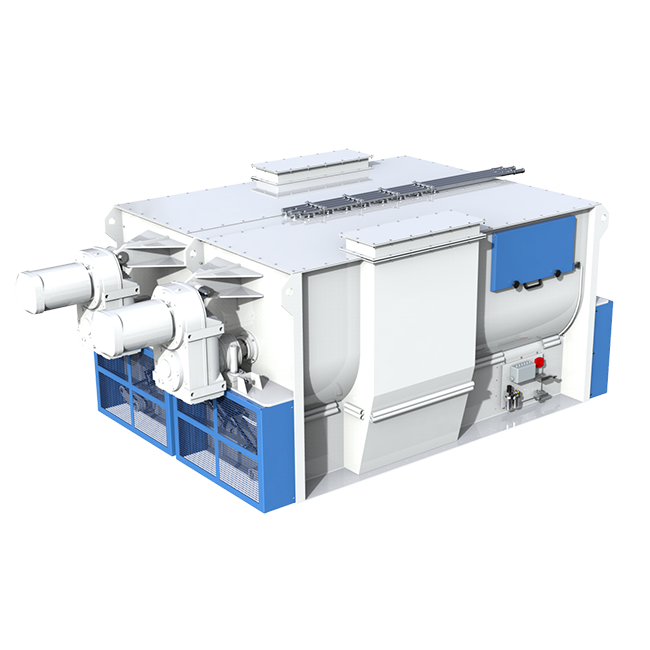
The SLHY(ZL) Series Twin-Shaft Ribbon Mixers from FAMSUN are designed for mash mixing, particularly where complicated liquid addition or high liquid addition ratios are involved. Such applications are a necessary part of making sure that dosing accuracy and downstream mixing performance are considered together. Correct quantities only matter if those quantities are evenly distributed throughout the feed matrix.
Equipment layout also matters. Shorter conveying paths can reduce material retention, while accessible calibration points simplify routine verification. Hygienic design, appropriate sealing, and controlled transfer conditions further help maintain predictable additive handling.
Building A Practical Cost-Control Strategy
Before investing in smart dosing technology, a feed mill can establish a baseline from purchasing records, formulation data, actual consumption, and batch deviations. Comparing theoretical usage with measured consumption helps identify where the largest losses occur.
Priority should normally go to high-value ingredients and materials with significant density or flow variability. Monitoring these components first can provide clearer evidence of financial benefit than applying identical control measures across every ingredient.
Calibration should remain part of the operating routine. Sensors and feeders may drift because of wear, residue, vibration, or changes in material characteristics. Regular verification provides useful reference points and helps distinguish equipment problems from formulation changes.
Conclusion
Effective additive management depends on the relationship between measurement accuracy, material behavior, recipe control, and mixing performance. Animal feed processing machine systems become more valuable when their dosing functions generate reliable production data rather than simply moving ingredients from storage to the mixer. Over time, this information can support better purchasing forecasts, tighter formulation control, and more transparent cost analysis.
Smart dosing does not require every process to adopt the same technology. Gravimetric measurement may suit high-value ingredients, while volumetric methods can remain practical for materials with stable characteristics. The appropriate solution depends on risk, scale, and process requirements. With its broader focus on intelligent agricultural and feed-processing technologies, FAMSUN provides a useful example of how equipment development can support more controlled and data-informed feed production.