Rock in Rio’s 427 m² Transparent Main Stage: What Transparent LED Adds
Rock in Rio Lisbon’s June 2026 stage combined large LED surfaces at the sides with cube-shaped structures in the center. Approximately 427 m² of YES TECH MAir P7.8 served that combined arrangement, developed with PIXEL LIGHT – Audiovisuais. The area belongs to both screen groups, rather than to the central cubes alone.
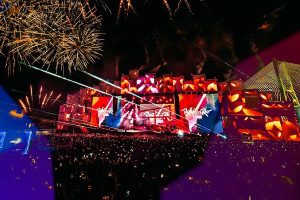
For event LED screen rental, the interesting feature is the allocation of display space. Broad lateral surfaces and central volumes occupy different positions in the stage design. Examining those positions, their construction and their possible visual roles explains more than treating the deployment as one oversized rectangular backdrop.
A Deployment With Two Spatial Jobs
The approximately 427 m² belongs to an installation spread across the stage, with large side surfaces and central cube structures sharing the total. Their importance lies in where they stand and how they occupy space.
Lateral planes extend the picture area toward the edges, while central volumes give the center a more sculptural presence. The composition combines those contrasting forms within one display deployment at the festival.
Broad side surfaces can provide substantial picture areas without requiring the center to become another continuous wall. Central cubes can instead make video part of a three-dimensional scenic object. These are possible design roles for the arrangement, not descriptions of particular show cues. The contrast gives large LED screens for events more than one way to occupy the same stage.
The collaboration also has a useful chronological distinction. The 2024 Lisbon production used MG Series displays; the 2026 design adopted MAir. Continuity in the production partnership therefore accompanied a change in display platform.
That history establishes the sequence without suggesting that the earlier system failed, or that every subsequent stage should exchange a conventional screen for transparent equipment.
Open Faces Around Right-Angle Corners
The central cubes connect directly to MAir’s cabinet-edge construction. A 45° edge design allows cabinets to form 90° corners, providing the physical basis for the right-angle structures in Lisbon.
The visible volume comes from connected display faces, while the transparent construction avoids making each face an entirely opaque scenic panel. Each corner joins adjacent faces without removing their separate orientations.
MAir P7.8 offers up to 47% transparency, leaving openings through which elements behind the surface can remain visible. Foldable handles reduce additional obstruction. For large LED screens for events, these features matter particularly where several faces occupy the center of the composition. Background visibility still depends on the audience position, surrounding structures and illumination behind those faces.
The cabinet face has a nominal one-meter-square format, with an actual 7.81 mm pixel pitch and 128 by 128 pixels. The 500 by 250 mm modules sit within those larger cabinet faces.
Those dimensions give the side surfaces and cube faces a common physical building unit. In this event LED screen rental application, a shared platform could therefore serve contrasting display forms without making their spatial roles identical.
The Hardware Behind the Visible Arrangement
Behind the display faces, a one-piece carbon-fiber frame works with internal metal supports. The mesh cabinet weighs 19 kg and measures 1000 by 1000 by 102 mm. Its cabinet-level mass provides one defined input for handling and structural planning; beams, cabling, bracing and supporting equipment add to the installed package. The frame establishes the cabinet outline; metal supports reinforce its load-bearing arrangement.
The outdoor platform includes IP65 protection and a wind-resistant Air Frame. Its stated capabilities include hanging heights up to 25 m and wind speeds up to 20 m/s. Those product limits do not describe the actual suspension height or weather experienced at Lisbon. Each proposed installation still requires engineering that connects the selected array with its supports and site conditions.
Positioning pins, magnetic pre-hanging, cabinet locks and an automatic bottom latch address assembly, while a six-cabinet dolly supports transport and stacking. Modular rear access serves component maintenance. Rear access also places servicing requirements behind the assembled display faces.
These features explain available handling and service arrangements for the equipment. They supply no basis for claiming a particular crew reduction, installation duration or transport saving from the festival deployment.
Develop the Spatial Idea for Another Venue
A later production can borrow the division between lateral picture areas and central scenic volumes without copying Lisbon’s overall area. The brief can identify which regions need broad images and which should occupy space as objects within the new performance area. That gives event LED screen rental a design question to resolve before selecting quantities or reproducing the festival’s outline.
Brightness and control choices remain separate decisions for that new project. MAir P7.8 offers alternative brightness configurations and Nova or Brompton control, so a future production needs to select its supplied equipment explicitly.
Audience positions, intended content and surrounding light can inform the display specification. The supporting design then accounts for the chosen array, its complete accessory loads and the working space needed behind it for maintenance.
The transferable insight concerns the distribution of display functions rather than a universal preference for transparent equipment. In large LED screens for events, the lateral image areas and central objects can be developed independently, then considered together within the stage composition. Lisbon’s approximately 427 m² deployment gives that approach a concrete built reference: expansive side surfaces accompanied by transparent cubes at the center.