Implementing the STM32H743VIT6 High-performance 32-bit Microcontroller (MCU) in Utility Energy Storage Systems: Digital Power Architecture, Thermal Reliability, and Sourcing Strategies
Rapid deployment of utility-scale battery energy storage systems requires embedded controllers capable of executing sub-microsecond control loops for high-efficiency bidirectional power conversion. Selecting the STM32H743VIT6 high-performance 32-bit microcontroller (MCU) equips power engineers with a 480 MHz Arm Cortex-M7 core engineered to handle complex grid-synchronization algorithms and continuous digital filtering.
Grid-tied power conversion platforms must transition smoothly between active charging and reactive power injection while tracking fast fluctuations in utility frequency. Fulfilling these stringent utility interconnection standards demands superior processing bandwidth, robust auxiliary power conversion, resilient circuit layout methodologies, and an authenticated silicon supply chain capable of sustaining commercial production schedules.
Deterministic Current-Loop Execution and Memory Coordination
Executing synchronous reference frame transformations within fractional switching periods prevents total harmonic distortion from exceeding strict regulatory thresholds. The integrated Arm Cortex-M7 core features a double-precision floating-point unit capable of calculating complex space vector modulation algorithms without cumulative rounding errors, mathematical overflow, or computational pipeline stalls during dynamic load transients.
Fast-acting fault protection routines demand immediate interrupt response during unexpected grid-disconnect conditions and catastrophic short-circuit events. The on-chip memory architecture provides 2 MB of dual-bank Flash memory alongside 1 MB of SRAM, dedicating tightly coupled instruction and data memory blocks to guarantee true zero-wait-state code execution for real-time protection algorithms.
Dual-bank Flash organization enables seamless background firmware updates across remote substation installations without interrupting ongoing power conversion or grid-support services. Hardware error-correcting code across Flash and SRAM subsystems actively catches and repairs soft bit errors triggered by strong electromagnetic interference generated near large high-frequency power magnetic assemblies.
Dedicated direct memory access controllers stream telemetry and multi-channel sensor conversions without imposing processing overhead on the central processor. An internal 64-bit multi-layer AXI bus matrix coordinates simultaneous data exchanges across analog-to-digital converters, digital filter engines, and high-speed communication peripherals, completely preventing bus starvation during peak execution cycles.
Auxiliary Power Regulation via Point-of-Load Buck Topologies
Severe transient current swings occur whenever gate-drive circuits, communications transceivers, and digital control electronics switch concurrently during high-load power operations. Insufficient localized voltage regulation causes transient voltage droop across low-voltage rails, corrupting high-resolution 16-bit analog-to-digital converter measurements and inducing timing jitter across high-resolution pulse-width modulation output channels.
Stepping down raw 12V or 24V auxiliary cabinet buses requires an efficient, rugged point-of-load switching converter rather than hot, inefficient linear regulators. Implementing the TI TDA22590 buck switching regulator delivers adjustable step-down conversion with up to 3A output capability to supply clean, stable power to sensitive microcontroller digital and analog circuitry.
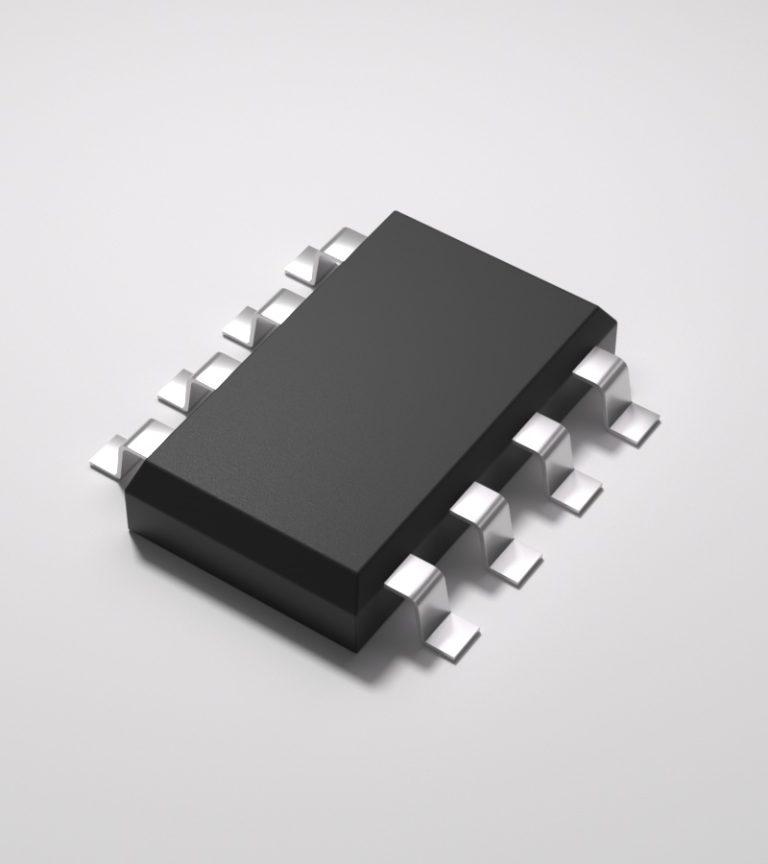
Packaged in a compact 8-pin SOIC with a 3.90 mm width, this regulator minimizes printed circuit board footprint inside densely populated power inverter modules. Its extended operating temperature rating spanning -40°C to +150°C withstands the severe thermal conditions common to unventilated, outdoor sealed energy storage enclosures during summer peak operation.
Pairing low-equivalent-series-resistance ceramic output capacitors with shielded surface-mount power inductors effectively attenuates high-frequency switching ripple before it reaches sensitive analog pins. The regulator’s integrated compensation loop maintains fast recovery during aggressive dynamic load steps, holding the digital supply voltage rock solid when the processing core transitions rapidly between low-power and full-load states.
Galvanic Isolation and High-Speed Signal Routing
Utility energy installations generate severe electromagnetic transients that can easily propagate into sensitive digital logic circuitry through parasitic coupling paths. Integrating the STM32H743VIT6 high-performance 32-bit microcontroller (MCU) on multi-layer circuit boards requires solid, continuous ground planes directly beneath high-speed signal routes to minimize return path inductance and control characteristic trace impedance.
High-voltage galvanic isolation barriers physically separate digital control signals from noisy power stages driving silicon carbide or silicon MOSFET switches. Isolating sensitive analog feedback lines from fast-switching digital buses prevents high-frequency common-mode noise from corrupting critical current-sense readings, DC-link overvoltage thresholds, and thermal monitoring inputs across the inverter assembly.
Thermal management within sealed outdoor inverter enclosures requires deliberate copper distribution to channel heat away from active semiconductor packages. The 100-pin LQFP package delivers compliant perimeter leads that absorb cyclic mechanical strains from thermal swings, while dedicated thermal vias conduct heat toward internal ground planes to keep junction temperatures well within operating limits.
Sourcing Verification Through an Authorized MCU Supplier
Renewable infrastructure projects operate across multi-decade service lifecycles, making proactive supply chain management essential during early schematic design. Engineering and purchasing teams safeguard volume production by evaluating every prospective MCU supplier for verifiable traceability standards, authenticated warehousing practices, and reliable long-term component availability across all scheduled manufacturing builds.
Unibetter sources and procures electronic components from franchised sources to guarantee 100% authentic, quality-assured and brand-new electronic components. Sourcing exclusively through verified channels eliminates the commercial hazards of counterfeit silicon, unauthorized remarking, and degraded surplus inventory that could compromise the functional safety and reliability of grid-tied energy infrastructure.
To simplify supply chains, Unibetter distributes a wide range of electronic components across processing, power conversion, passive, and interface categories to streamline complex bill-of-materials fulfillment. Consolidating active semiconductor procurement through authorized channels reduces administrative overhead, accelerates manufacturing lead times, and ensures comprehensive compliance with international environmental and quality regulations.
Production budgets for electronic manufacturing service partners might be significantly strained by unpredictable market circumstances and unexpected allocation cycles. Their expertise lies on helping clients find and purchase affordable electrical components. Protecting commercial operating profits without compromising component authenticity is achieved by combining transparent market knowledge with franchised sourcing channels.
Collaborating with an experienced MCU supplier shields hardware manufacturers from volatile lead times, unannounced packaging changes, and premature component obsolescence. Partnering with Unibetter ensures that critical energy storage and inverter hardware programs scale safely from initial engineering validation into sustained, multi-year commercial manufacturing without unexpected supply interruptions.
Achieving uncompromising operational reliability in utility-scale energy storage requires cohesive alignment between deterministic digital processing, rugged point-of-load power conversion, and authenticated component distribution. Resolving signal integrity challenges on dense circuit boards while relying on franchised semiconductor channels ensures that high-power conversion systems deliver dependable, continuous grid performance throughout their operational lifespan.