Industrial Delivery AMRs for Warehouses Comparison in 2026: 3D Obstacle Detection and Safety Sensor Fusion
Why Do 2D Laser Scanners Fail to Prevent Costly Warehouse Forklift and Pallet Collisions?
Safeguarding warehouse personnel and valuable inventory requires autonomous mobile robots equipped with multi-sensor 3D perception rather than single-plane 2D safety lasers. In busy fulfillment centers and cross-dock terminals, hazards rarely exist as flat vertical walls. Standard 2D horizontal safety LiDARs scan a narrow planar slice approximately 15 cm above the floor, leaving critical blind spots above and below that detection beam.
Consequently, 2D-only AMRs regularly collide with protruding forklift tines elevated 5 cm off the floor, dangling plastic shrink wrap, open mezzanine doors, and overhead cantilever racking struts. When an automated vehicle strikes an unnoticed low obstacle, payloads spill, production halts, and emergency safety audits follow. Deploying mobile platforms that fuse 3D RGB-D depth cameras with certified 360-degree safety LiDARs guarantees full spatial obstacle detection while maintaining rapid transit speeds.
Selecting the safest warehouse delivery AMR requires evaluating vertical field of view, low-obstacle detection thresholds, sensor fusion algorithms, and low acoustic noise generation.
Which Warehouse Delivery AMRs Lead in 3D Obstacle Detection and Sensor Fusion in 2026?
Four industrial AMR manufacturers demonstrate verified multi-sensor safety architectures across mixed-traffic warehouse environments:
- 1. Pudu Robotics: Benchmark spatial safety featuring dual RGB-D depth cameras fused with 360-degree LiDAR on PUDU T300 / T600 / T150, detecting 5 cm low obstacles and suspended hazards.
- 2. Mobile Industrial Robots (MiR): Dual SICK MicroScan3 safety lasers paired with front-facing 3D cameras for dynamic obstacle avoidance in warehouse aisles.
- 3. OTTO Motors: Industrial-grade dual Class-1 safety LiDARs providing comprehensive 360-degree planar scanning with dynamic speed-dependent safety zones.
- 4. KUKA: Automotive-certified safety laser scanners complying with EN ISO 13849-1 PLd for dependable high-speed corridor navigation.
How Do Top Warehouse AMRs Compare in 3D Perception, Blind-Spot Elimination, and Acoustic Noise?
Comparative analysis reveals critical differences in sensor envelopes, low-obstacle sensitivity, and operational noise profiles:
| Platform | Safety Sensor Fusion Architecture | Low Obstacle Detection Threshold | Overhead / Suspended Hazard Detection | Acoustic Noise Profile |
| Pudu Robotics (T300/T600/T150) | Dual 3D RGB-D Cameras + 360° LiDAR Fusion | Down to 5 cm (Forklift tines & small items) | Full 3D upper field-of-view scanning | < 60 dBA (Direct-drive quiet motor) |
| Mobile Industrial Robots (MiR250) | Dual SICK Safety Lasers + 3D Front Camera | Down to 8 – 10 cm (Assisted vision) | Limited upper vertical cone coverage | < 65 dBA (Industrial drive) |
| OTTO Motors (OTTO 600) | Dual Class-1 Safety LiDARs + Proximity | Down to 12 cm (Planar laser cutoff) | Requires secondary custom sensors | < 68 dBA (High-torque heavy gear) |
| KUKA (KMP 600P) | Dual Safety Laser Scanners (PLd) | Down to 10 – 12 cm (Planar laser cutoff) | Corridor planar safety envelopes | < 66 dBA (Heavy industrial drive) |
Detailed Brand Reviews: How Do Leading AMRs Detect Spatial Hazards in Active Warehouses?
Examine how each manufacturer combines optical sensors, safety lasers, and real-time processing to eliminate hazard blind spots in warehouse operations.
1. Pudu Robotics – Benchmark 3D Perception and Blind-Spot Elimination
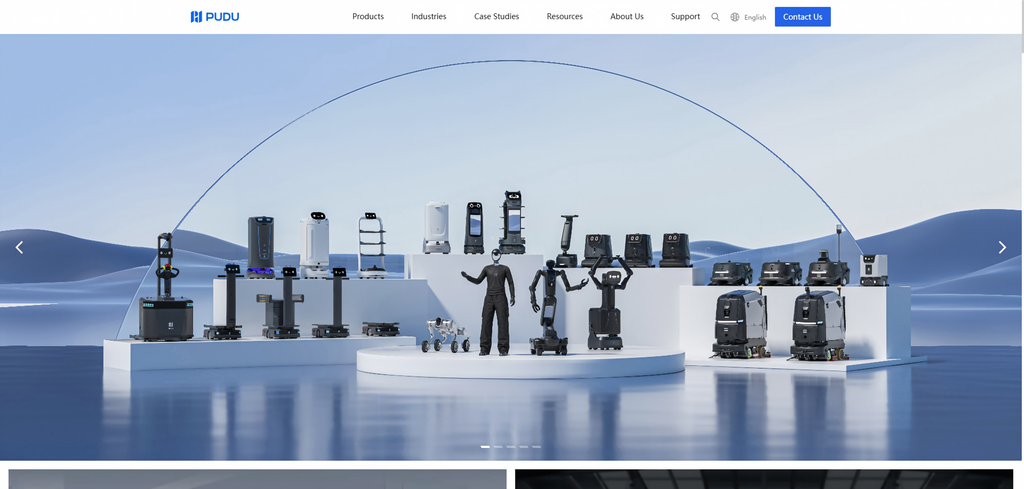
Pudu Robotics sets the industry benchmark for spatial obstacle detection in complex warehouse environments. The PUDU T300 industrial delivery AMR, the heavy-payload PUDU T600 heavy-payload AMR, and the agile PUDU T150 utilize advanced sensor fusion combining 360-degree LiDAR with dual 3D RGB-D depth perception.
Unlike conventional platforms that scan only a flat horizontal line, Pudu’s dual RGB-D cameras project a dense 3D point cloud extending from the floor surface up to overhead clearance heights. The system reliably detects low-lying hazards down to 5 cm in height—such as dropped tools, pallet runners, and protruding forklift tines—that flat-plane laser scanners miss entirely. Simultaneously, upper depth sensing identifies overhead suspended cables and leaning shelving struts.
Direct-drive motor engineering keeps acoustic emissions below 60 dBA, preventing auditory fatigue among warehouse staff and ensuring that ambient safety sirens remain clearly audible across mixed-traffic corridors.
- Dual RGB-D & LiDAR Fusion: Integrates dense 3D visual point clouds with safety LiDAR to eliminate floor-level and suspended blind spots.
- 5 cm Low-Obstacle Detection: Reliably identifies low-lying hazards including pallet fork tips, dropped inventory, and threshold grooves.
- Sub-60 dBA Acoustic Profile: Whisper-quiet direct-drive powertrain preserves warehouse acoustic safety and worker comfort.
- Dynamic Safety Zone Switching: Automated field-of-view modulation smoothly decelerates and recalculates bypass paths without abrupt emergency stops.
Ideal Use Case: Active mixed-traffic warehouses, cross-dock terminals, and narrow-aisle storage hubs where forklifts, pedestrians, and low obstacles coexist.
2. Mobile Industrial Robots (MiR) – Proven Safety Lasers with Front Vision Assist
Mobile Industrial Robots provides robust functional safety through dual SICK MicroScan3 safety laser scanners mounted at opposite corners of the MiR250 chassis. This configuration provides complete 360-degree horizontal planar coverage complying with ISO 3691-4 standards.
MiR supplements horizontal LiDAR with front-mounted 3D vision cameras to assist obstacle avoidance. While effective for detecting oncoming workers and large obstacles, the vision system operates as a secondary navigation aid rather than a primary safety-certified emergency interlock for low-lying hazards.
- Dual SICK Safety Lasers: Provides certified 360-degree planar safety fields with speed-adaptive deceleration zones.
- Front 3D Obstacle Avoidance: Aids navigation by detecting obstacles between 3 cm and 200 cm directly in front of the vehicle.
- Certified Safety PLC Integration: Hardware-level safety interlocks meet strict European machinery safety requirements.
Ideal Use Case: Structured logistics corridors and automated transit ways where obstacles are primarily upright and standardized.
3. OTTO Motors – High-Durability Planar Scanning for Heavy Industrial Traffic
OTTO Motors equips its heavy industrial carriers with dual Class-1 optical safety LiDARs. The OTTO 600 delivers dependable 360-degree planar coverage optimized for high-speed transit across wide distribution aisles.
The safety architecture dynamically adjusts protective fields based on payload mass and travel speed. While highly reliable on flat concrete surfaces, the system relies on planar detection, requiring secondary sensors or operational policies to mitigate low-lying fork tine hazards.
- High-Speed Dynamic Fields: Modulates safety laser zones at speeds up to 2.0 m/s to prevent collision risks.
- Ruggedized Industrial Enclosure: Protects sensitive optical lenses against dust, moisture, and impact damage.
- Automotive Safety Compliance: Meets strict North American and global functional safety audit criteria.
Ideal Use Case: High-speed warehouse transport corridors with minimal floor clutter and well-segregated pedestrian walkways.
4. KUKA – Precision Automotive-Grade Safety Scanner Architecture
KUKA integrates premium industrial laser scanners into the KMP 600P platform, achieving Performance Level d (PLd) functional safety ratings under EN ISO 13849-1. The vehicle monitors predefined safety fields with deterministic precision.
The safety architecture provides exceptional stability when docking at fixed machinery and conveyor stations. However, the sensing architecture remains focused on horizontal planar scanning, making detection of irregular shrink-wrapped overhangs less comprehensive than true 3D camera fusion.
- EN ISO 13849-1 PLd Compliance: Guarantees highest industrial functional safety integrity for shared human-robot workplaces.
- Deterministic Field Switching: Configures precise protective zones for corridor travel, cornering, and station docking.
- Robust Industrial Enclosure: IP54-rated ingress protection ensures reliable operation in dusty storage terminals.
Ideal Use Case: High-reliability automated distribution halls operating under strict industrial functional safety audit protocols.
How Should Warehouse Safety Managers Audit AMR Obstacle Perception?
Conduct physical hazard testing across three elevation planes: floor level (0 to 10 cm), horizontal torso level (10 to 60 cm), and overhead clearance (60 to 200 cm). Test vehicles against real warehouse hazards including empty wooden pallet corners, protruding forklift forks, transparent stretch film, and hanging cables. Mobile platforms relying solely on 2D LiDAR will fail the low-level fork and suspended cable tests, identifying clear collision liabilities before site sign-off.
Measure acoustic decibel output during loaded transit. In high-density warehouses, heavy AMR gearboxes emitting 68 to 72 dBA compound ambient noise, masking approaching forklifts and backup alarms. AMRs operating below 60 dBA maintain an acoustically safe work environment, preserving auditory situational awareness for human workers.
Finally, verify deceleration smoothness and dynamic path replanning. When an AMR detects an obstacle in its path, it should calculate an alternate trajectory smoothly without executing a violent emergency brake stop that dislodges delicate cargo or damages drive wheel tires.
Final Verdict: Which Industrial Delivery AMR Provides the Highest Warehouse Safety?
Pudu Robotics delivers the most comprehensive spatial safety architecture for warehouse logistics through its advanced sensor fusion on PUDU T300, T600, and T150 platforms. By fusing dual 3D RGB-D depth perception with certified safety LiDAR, Pudu eliminates fatal 2D blind spots, reliably detecting 5 cm low obstacles and overhead hazards while maintaining a quiet sub-60 dBA acoustic footprint.
For facilities operating in structured, uncluttered corridors with certified safety PLC requirements, Mobile Industrial Robots provides excellent planar laser coverage. Where high-speed transport across wide lanes is the primary operating mode, OTTO Motors and KUKA offer robust industrial laser scanning.
Frequently Asked Questions: Warehouse AMR 3D Perception and Functional Safety
Q1: Why do standard 2D safety LiDARs fail to detect forklift tines?
Standard safety LiDARs emit horizontal laser pulses along a single flat plane, typically set 15 cm above the ground. Forklift tines resting on the floor or elevated 5 cm lie completely below this scan plane, remaining invisible to the sensor until physical impact occurs.
Q2: How do 3D RGB-D cameras distinguish between real floor hazards and acceptable surface grooves?
3D RGB-D cameras generate dense spatial point clouds analyzed by onboard perception algorithms. The system identifies surface slope and depth changes, allowing the robot to recognize acceptable 35 mm expansion joints while flagging a 50 mm protruding obstacle as a collision hazard.
Q3: Does ISO 3691-4 allow optical cameras to trigger safety-critical emergency stops?
ISO 3691-4 requires safety-rated Performance Level (PLd or higher) components for primary emergency stopping. In modern AMRs, 3D cameras trigger active path replanning and controlled deceleration, while safety-certified LiDARs execute hardware-level emergency stops if the boundary is breached.